

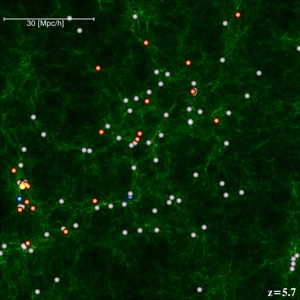
The next era of large redshift surveys is also expected to revolutionize the field. Ongoing and future surveys are planned to map large areas (in some cases the whole extragalactic sky) with unprecedented depth. One of the main science cases is to constrain the nature of the dark energy by measuring the Large scale structure (LSS) of the Universe. The huge amount of data resulting from these surveys will also provide unprecedented statistics to probe galaxy formation to high redshifts, making possible to explore the epoch where the first galaxies formed.
Over the last few years our understanding of galaxy formation and evolution has improved dramatically driven by the outcome of galaxy surveys such as the SDSS and 2dFGRS. These surveys became robust probes of cosmology and galaxy formation by mapping the present-day Universe with unprecedented detail
The backbone of my research is the semi-analytical technique to study galaxy formation. The basic philosophy of these models is to use simplified calculations, or recipes, to account for all of the important processes which regulate the formation and evolution of galaxies. This allows the model to incorporate a large variety of phenomena from different areas of astrophysics, and also ensures the flexibility to develop and incorporate additional physical ingredients of varying complexity. In this way, semianalytical models can be regarded as a synthesis of many different techniques. Despite the simplifications made, semi-analytical models are based on a well understood hierarchical clustering cosmology, in which dark matter haloes (gravitationally bound dark matter structures) are the hosts of galaxies, and thus
the formation and evolution of these structures determines the cosmic history of galaxies.
Orsi et al. (2008)
In my last work, we study the properties of Ly-alpha emitters in a cosmological framework by computing the escape of Ly-alpha photons through galactic outflows. We combine the GALFORM semi-analytical model of galaxy formation with a Monte Carlo Ly-alpha radiative transfer code. The properties of Ly-alpha emitters at 0<z<7 are predicted using two outflow geometries: a Shell of neutral gas and a Wind ejecting material, both expanding at constant velocity. The models are consistent with the observationally inferred Ly-alpha escape fractions, equivalent width distributions and with the shape of the Ly-alpha line from composite spectra. We predict that Ly-alpha emitters constitute a subset of the galaxy population with lower metallicities, lower instantaneous star formation rates and larger sizes than the overall population at the same UV luminosity.
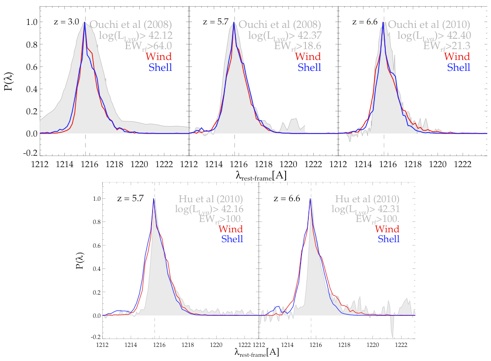
I have focused my research in understanding the properties of galaxies detected by their emission lines. This technique has been very succesful in detecting active star forming galaxies at high redshifts.
Orsi et al. (2011)