Abstract Diploma Thesis
'Stellar Activity in the Open Cluster NGC 2451'
In this thesis optical and X-Ray Observations of the open cluster NGC 2451 are
analysed. This Object actually consists of two open clusters in the same
line-of-sight. The closer one, NGC 2451 A, ranks with 190 pc distance among
the 10 closests clusters at all. Besides this close distance NGC 2451 is also
interesting because of its realitivly young age (about 50 Myrs) and its
suspected low metallicity. Until now it has been studied rather briefly with
photoelectrical photometry and proper motion studies only of the brightest
members. This is mainly due to its large contamination with foreground and
background stars caused by its short distance to the galactic plane.
In order to obtain better membership lists the X-Ray data were used to
select new member candidates. This is possible because young stars are very
active and therefore very X-Ray bright. Furthermore X-Rays, especially soft
X-Rays, suffer stronger absorbtion in the Interstellar Media and so only the
X-Ray brightest background stars are contaminating the X-Ray data. Another
important aspect of the X-Ray data is the possiblility to study the stellar
activity of the cluster members and the temporal evolution of the activity.
To identify the X-Ray sources with stars and in order to classify these stars
optical CCD-Observations were made in UBVR-filters. Our studies confirm the
presence of two stars clusters in the same line-of-sight. A total of 188 X-Ray
sources were found of which 147 could be identified with optical counterparts.
Of these, 38 are candidates for NGC 2451 A and 53 for NGC 2451 B. 22 stars are
candidates for one of the two clusters, but with the existing data it is not
possible to deceide to which cluster they belong. 36 Objects are possible
non-members.
These new member candidates extend the main-sequences from the known
B- and A-stars over the F-, G- and K-stars down to the M-dwarfs. They have
X-Ray luminosities in the range of 1028 erg s-1 to
1030 erg s-1, which is comparable with the luminosities
of other clusters with an age between 50 and 100 million years.
A more detailed analyses of the X-Ray-data showed a stronger absorbtion of
NGC 2451 B in the regime of soft X-Rays, because of its greater distance.
Furthermore 4 X-Ray-flares were detected whose physical parameters are
explained by a simple loop-model and compared with other flares. Remarkably
is also the X-Ray detection of the K2.5Ib-II Supergiant c Puppis, because it
is usually assumed that such stars show no X-Ray emission at all. Its known
companion is an early A-type star, who can also not responsibly for the
X-Ray-luminosity of 1.05 x 1030 erg s-1, because such
stars are weak or no sources at all. Interestingly the X-Ray luminositiy of
c Pup decreases to 3.1 x 1029 erg s-1 a year later.
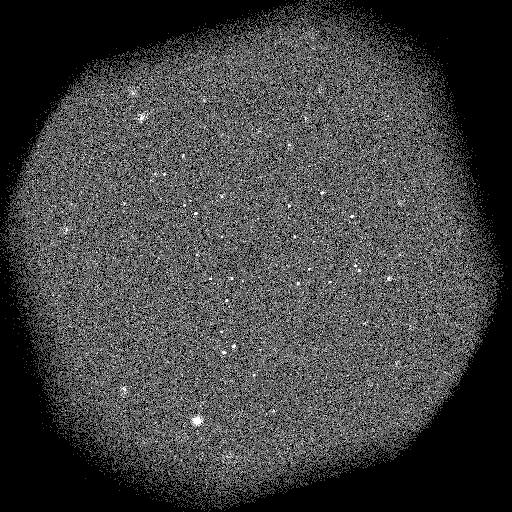
The picture below shows the NGC 2451 Region in x-ray-wavelength. It is
processed out of Observations made with the High-Resolution Imager (HRI) of
the ROSAT-X-Ray-Satellite.
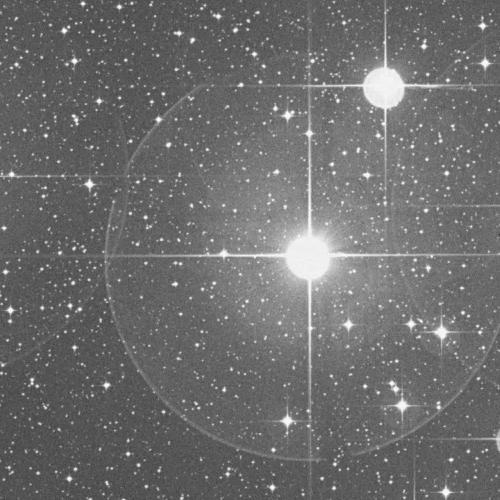
The inner part of NGC 2451 (14' x 14'; about one-quarter of HRI-picture).
Image taken during the 'Science and Engineering Research Council Survey'
(SERC) and obtained from the
SIMBAD archive.
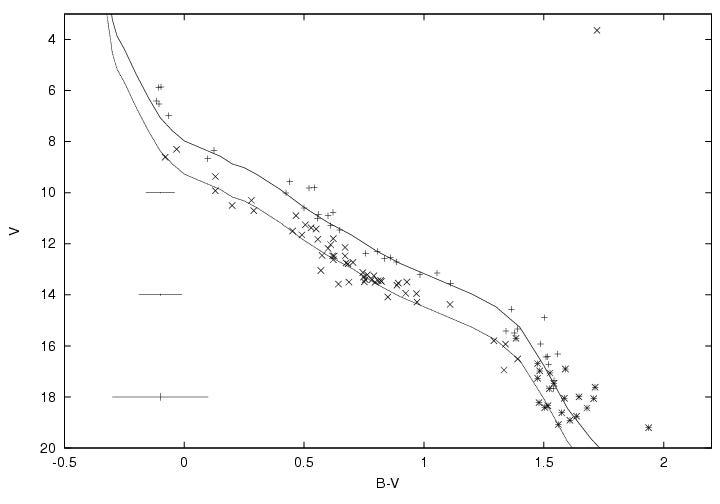
Colour-Magnitude-Diagram of the new cluster member candidates. '+' NGC 2451 A,
'x' NGC 2451 B, '*' unclear
Two ZAMS are plotted, the upper for cluster A (190 pc) the lower for cluster B (360 pc).
The errors are represended by the crosses in the left half of the diagram.
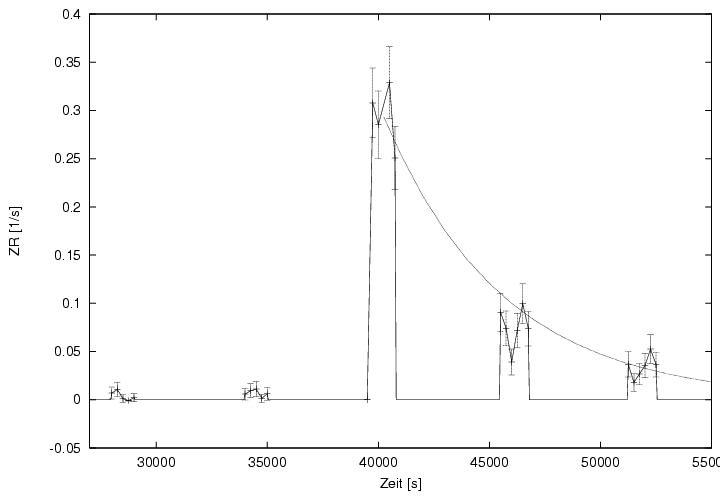
Lightcurve of an X-Ray flare in source X-128 with errorbars and an
exponential decay fitted.