Galaxy Clusters as Trash Compactors: Why Denser Galaxies Survive Closer to the Center
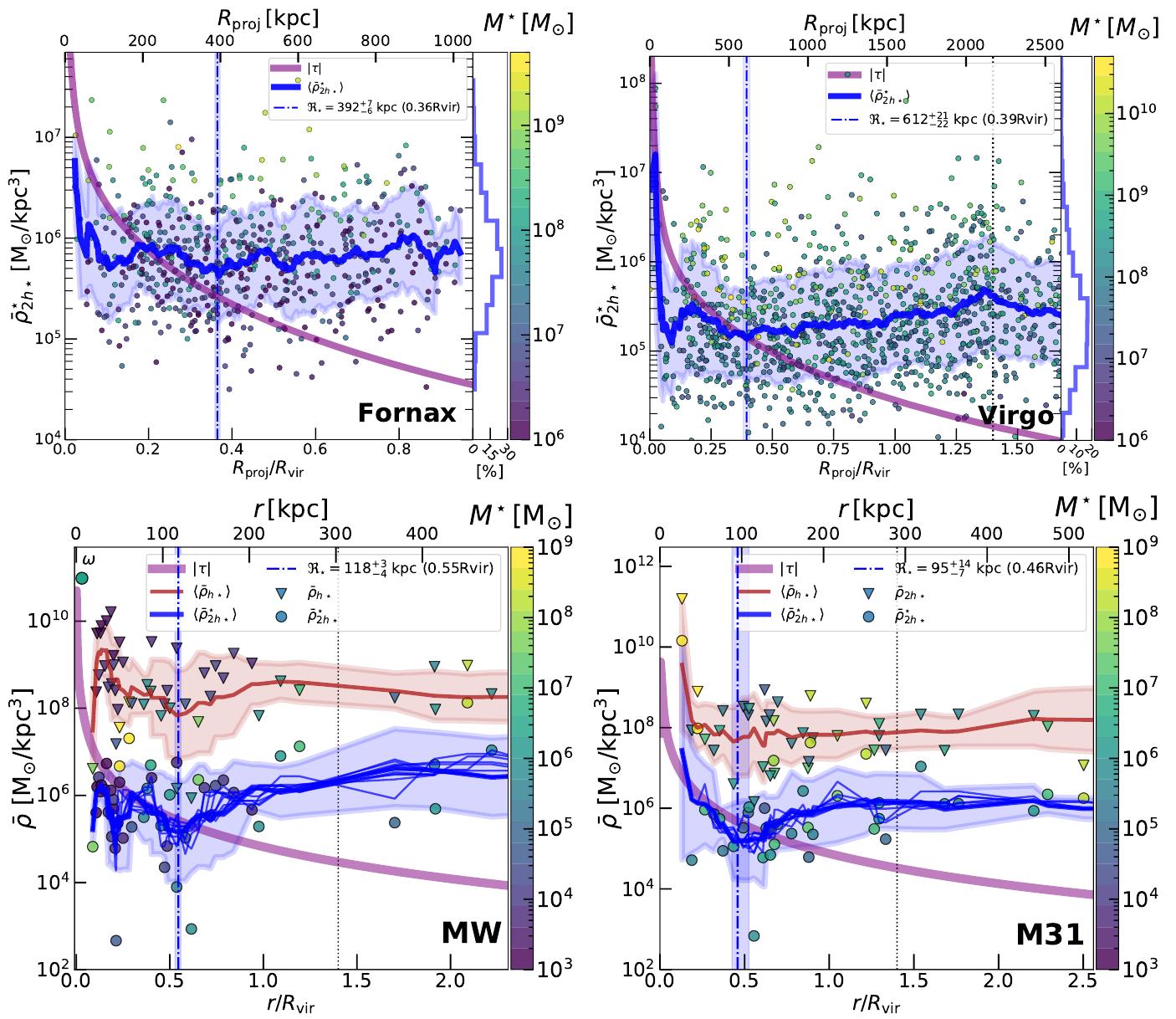
Mean stellar mass densities of satellite galaxies in four observed systems: Fornax, Virgo, the Milky Way, and Andromeda; plotted against distance from the host center. The purple curve is the host's tidal field. Blue curves show the running average of satellite densities.
Galaxy clusters are gravitational monsters. Anything that falls in, satellite galaxies, dwarfs, star clusters, gets squeezed, stripped, and reshaped by tidal forces that grow more ferocious closer to the center. Everyone knew this in principle. What we show in our new paper is that it works like a sorting machine: only the dense survive the inner zone.
The core insight is elegant. As a satellite galaxy orbits inward, the host cluster's tidal field peels off its outer layers: dark matter first, then stars, like an onion. What remains is the dense core. So galaxies found near the center must be denser, on average, than those in the outskirts. We call this the ρ̄–r relation: mean mass density anti-correlates with cluster-centric distance.
We attack this relation from three angles: a semi-analytical toy model stripping satellites in a Fornax-like cluster over 10 Gyr, ~300 galaxy clusters from IllustrisTNG and EAGLE cosmological simulations, and real photometric data from the Fornax and Virgo clusters plus Local Group kinematics. We find that all three converge on the same answer: inside a "transition radius" of about half the virial radius (0.5 Rvir), average satellite stellar mass densities rise sharply toward the center, tracking the host's tidal field strength. Beyond that radius, the tidal field is too weak to meaningfully strip most satellites, and densities flatten out.
What makes this result particularly useful is that the transition radius is measurable from photometry alone. You don't need spectroscopy, velocity dispersions, or orbital solutions. Just stellar masses and half-light radii from an imaging survey, like the NGFS. That makes this transition radius a practical diagnostic for mapping where tidal processing gets serious in any galaxy cluster, even distant ones. We find that the statistical significance is impressive: a null-hypothesis test across all four observed systems gives a combined probability of ~5σ that the density transition arises by chance. A nice subtlety is that neither mass nor size alone determines a satellite's fate: it's the mean density that matters. A massive but fluffy galaxy can be destroyed faster than a compact dwarf.
The implications ripple outward. Classic scaling laws, such as the morphology-density relation, mass-size relations for dwarfs, all need to account for the cluster's tidal field selectively sculpting its satellite population from the inside out. With upcoming surveys like Rubin/LSST and Euclid, satellite density profiles could become precision probes of dark matter halo structure without a single spectrum.
Related Papers