The Third Cosmic Wanderer: What 3I/ATLAS Tells Us About Ancient Interstellar Visitors
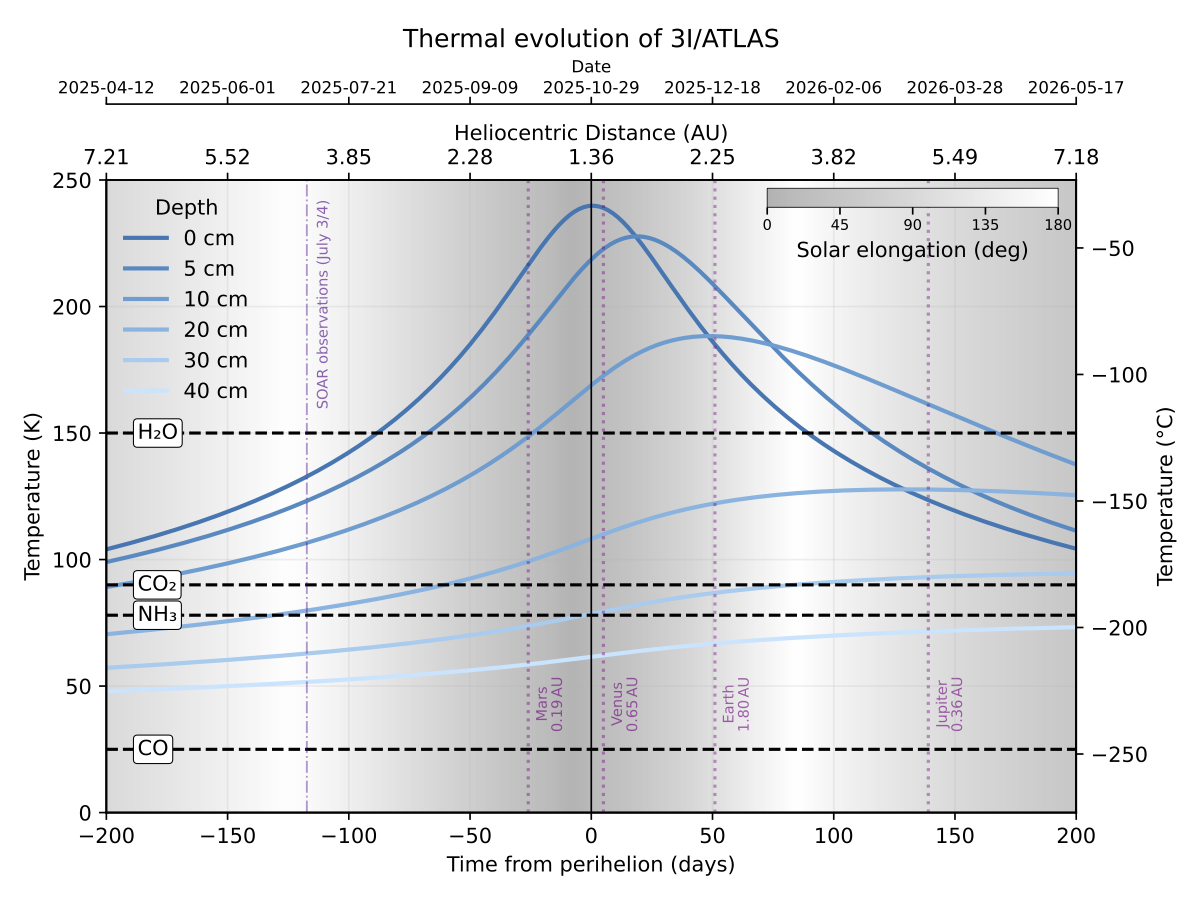
Modeled thermal evolution of 3I/ATLAS during its perihelion passage.
Picture this: you're sitting at your birthday party when news breaks that we've just spotted our third visitor from another star system. That's exactly what happened to me when 3I/ATLAS showed up in July 2025, racing toward the Sun at a mind-bending 58 km/s, making it the most hyperbolic object we've ever seen. Our team jumped at the chance to study this ancient wanderer using the SOAR telescope in Chile.
Here's what we found. 3I is growing a coma (that fuzzy cloud of dust around comets) but we can't detect (yet) any of the usual gas emissions you'd expect. No CN, no C2, nothing. Our thermal models show this makes sense at 4.4 AU from the Sun, where it's still too cold for typical ice sublimation. But then what's causing the dust?
The answer might lie in 3I's incredible journey. This object has been wandering the Milky Way for potentially billions of years, getting bombarded by cosmic radiation and solar wind from countless stellar encounters. We're seeing a spectral signature that screams "complex organics"; those reddish, carbon-rich compounds that form when pristine ices get cooked by radiation over cosmic timescales.
What really excites us is that 3I might be our first glimpse of material from the Milky Way's thick disk, i.e. from ancient stellar nurseries during a time when our galaxy was young. As it approaches perihelion in October, we expect the real fireworks to begin. This cosmic fossil could rewrite our understanding of how planetary systems formed in the early universe, one spectrum at a time.
Related Papers